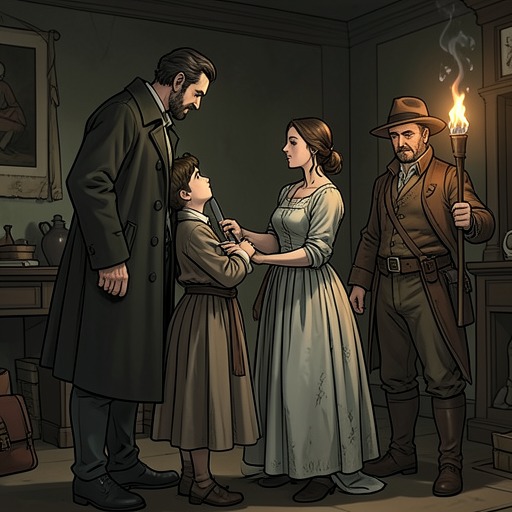
“A place where serenity and courtesy connect”
Blood Canticle“A place where serenity and courtesy connect” is Mona’s concise description of the maturity she hopes to find as a vampire. The phrase emerges from her effort to understand how her new existence changes her conduct toward human beings, and it carries a wider resonance in a story repeatedly concerned with care: who may choose it, what knowledge can make it possible, and when protection risks becoming control.
Origin and Meaning
After Quinn had spent hours cautioning Mona about how she treated Rowan, Michael, and Dolly Jean, Mona acknowledged that she had been too quick to speak of them simply as human beings. She recognized that they had their own ways and that it had not been her place to interrupt Rowan. Rather than treating those corrections as etiquette alone, she described a need to find her maturity in the Blood, then gave that aspiration its memorable formulation: a place where serenity and courtesy meet. She also admitted that she remained far from it.
The phrase makes maturity a practice of restraint and regard, not merely a change in status. Mona’s realization is relational: Quinn’s instruction gives her a reason to reconsider how she speaks and behaves around people whose lives differ from her own. Her acknowledgment does not erase the confidence or abruptness that prompted his advice; it marks her willingness to learn how her power and identity affect others.
Quinn’s Guidance and Lestat’s Response
Lestat responds with visible skepticism toward Mona’s contrition, but the words themselves please him. He studies her appearance, including the black cuffs and high-heeled shoes, while distinguishing the style of her statement from its authorship: although Quinn has taught her, Lestat believes the thought and its expression are genuinely hers. He reads Quinn’s response to her as confirmation of that independence. The moment therefore holds instruction and self-discovery together: Mona has listened to Quinn without simply repeating him.
The phrase also sits within a broader conversation about choice and care. When Mona was gravely ill and asked to be transformed, Lestat weighed the choice against the suffering of her long hospitalization and the brief relief she hoped to gain. Quinn urged him to save her, while Lestat recognized that the family was approaching. The later language of courtesy and patience does not resolve those questions of intervention, but it gives Mona a vocabulary for living with others after the decision that changed her life.
Resonance with Care and Protection
Elsewhere, Rowan explains that Taltos milk is necessary for a Taltos infant’s development and may also have curative properties for humans. Her account introduces a difficult boundary between knowledge that could heal and the human cost associated with it. That possibility gives the phrase’s pairing of serenity and courtesy an ethical resonance: care requires attention not only to an intended benefit, but also to the people whose bodies and lives are implicated.
A related idea appears in Lorkyn’s account of the community she hopes to build. She clarifies to Mona that she means a protected environment in which the Taltos can live, function, and thrive—not confinement for study. Lorkyn wants to continue her medical studies and become a doctor; Rowan has accepted her as a pupil, and Lorkyn sees useful work for Oberon and Miravelle as part of a self-contained world where the Taltos can be supervised without conspicuous restrictions and live in peace. Together, these episodes extend Mona’s phrase beyond personal manners: serenity and courtesy suggest a standard for relationships and communities in which protection should support agency, learning, and life.